Wednesday, February 2, 2011

The Unsinkable HPL


News of a new online zine of Lovecraftian fiction - The Lovecraft Ezine.


Issue one is currently available online and features new fiction from Bruce L. Priddy, William Meikle, John Prescott and Bruce Durham.


With both this and the excellent Innsmouth Free Press (new issue available soon), it seems that the influence of H.P Lovecraft and appetite for Mythos fiction is continuing on apace. From pulpster to literary giant... not bad going.


As HPL himself wrote: “That is not dead which can eternal lie, yet with stranger aeons, even Death may die.”


You can find out more about The Lovecraft Ezine here http://lovecraftzine.wordpress.com/ and Innsmouth Free Press here: http://www.innsmouthfreepress.com/

Friday, January 21, 2011

HOORAY FOR HOK


Next month sees the release of Battle In The Dawn: The Complete Hok the Mighty by Manly Wade Wellman.

Published by the very wonderful Planet Stories imprint of Piazo, this represents the first time that Wellman's prehistoric hero appears in a complete and authorized edition.

I've only read a couple of the Hok stories in the past and they are wonderful - stone age sword and sorcery (so to speak) stories that first appeared in the 1930's and which Wellman added to even up to the time of his death. In fact, one of the last incomplete fragments that Wellman left behind was the start of a new Hok story.

I'm really excited about this new edition, Planet Stories have done a great job of keeping pulp fiction alive, publishing collections and novels by such authors as CL Moore, Henry Kuttner, Michael Moorcock, Leigh Brackett and Robert E. Howard, most of which have been sadly out of print for many years (such as Kuttner's Elak of Atlantis stories which deserve a place on the shelves of any self-respecting sword and sorcery fanatic).

You can find out more about Hok, Battle In the Dawn and Planet Stories here:

Sunday, January 16, 2011

TUSSAGAROTH REVISITED


Some more nice words about my S&S Mythos tale The Song of Tussagaroth, which appeared in the October issue of Innsmouth Free Press, this time from Angela Spencer in the pages of Rise Reviews.

“The Song of Tussagaroth” by James Lecky proved to be an unexpected piece to find in the magazine. This lovely piece of dark fantasy was more closely related to Howard’s Hyborian Age or Lovecraft’s Dreamlands than the usual nods to Lovecraft’s work. As best I can tell it is the author’s own setting as well, as is the old god Tussagaroth that lends the story its name. It was a fun piece to read and an interesting break from the other stories."

Angela has good things to say about the magazine, too. You can read the full thing here:

Saturday, January 15, 2011

WITH MANY SHADES


A quick plug for my other blog, With Many Shades. As regular readers might know. With Many Shades is a listing of various online, and occasionally print, publications that fall into the category of science fiction and fantasy.

It's a hopefully decent enough resource for both reader and writers. if you haven't checked it out yet then please do (and maybe consider following the blog, too, it needs all the followers it can get)

And that's all I have to say about that.

Tuesday, January 4, 2011

THIN BLOOD AT AURORA WOLF


My Celtic flavoured fantasy Thin Blood is currently available to read at Aurora Wolf.

It's the first of what I hope will be a new series of tales set in Orialla, which is my fantasy version of Ireland.

The stories (there are currently two of them) have a slightly more upbeat tempo than most of my other pieces - at least, I think they do, it's hard to tell sometimes.

This issue also contains a new story, Masks, by the excellent Megan Arkenberg.

You can find Thin Blood here: http://aurorawolf.com/2011/01/thin-blood/

Monday, January 3, 2011

GETTING INTO 2011


Well, the New Year has begun and I think a lot of resolutions have already been broken. Not by me, though, since I didn't make any.

One thing I did make my mind up to do, however, was to revisit a few of those stories that remain unfinished and see if the passing of time has helped with those tricky little plot turns that effectively painted them into corners.

What struck me first and foremost was exactly how many of these stories I have: two unfinished Tulun stories (one of which is currently hovering at the 8,000 word mark), Three that fall into my Shining Cities sequence and at least half a dozen others ranging from a new Mythos sword and sorcery story to a steampunkesque 'multiverse' tale to the odd foray in 'straightforward' sf.

Most of all, I realised that I have 14,000 words of a novella that I've been working at on-and-off for the last while (it's a sort of alternative world thing where the sorce of magic is dragon's blood and the dragons - or dreki - are hunted for them in much the same way that whales were hunted during the 19th century).

With no false modesty, most of these stories aren't bad (although a couple are right stinkers and I know why I gave up on them) and certainly deserve to be finished. After all, no one is going to read a story that still sitting on my hard drive or in my notebooks (this, by the way, applies to every writer and not just me).

So I have made up my mind to get these particular stories finished. Not a resolution, you understand, more of a duty to those characters who have remained in literary limbo for too long. Hopefully they'll forgive me for leaving them.

Sunday, January 2, 2011

HEROIC FANTASY QUARTERLY ISSUE 7


The newest issue of Heroic Fantasy Quarterly is live and unleashed for your reading pleasure.

Fiction Contents

LORD OF THE BRASS HOST, by Dariel Quiogue
Dare we call this beauty a tale of S&S steampunk upon the steppes? We dare!

THE LAST FREE BEAR, by J. S. Bangs
Hope drives them across the tundra, and revenge into a world of legend!

SHATTERING THE SPEAR, by P. Djeli Clark
When the forces of the Witch Priest threaten the Southlands, only the mighty Zhusa and their allies stand in the way. But are unbreakable spears enough to stop this ancient evil . . .

Poetry Contents

LAMENT FOR THE FATHERS, by Joshua Hampton
A poem seemingly straight from the middle ages! With this his second poem to grace our electronic pages, Mr. Hampton currently reigns as HFQ’s Poet Laureate. (You can check out the prior here, from the halcyon days of ’09.)

METTLE, by Scott Matthews
We couldn’t have asked for a better winter poem. Short but powerful, certain lines of this piece are sure to warm the hearts of heroic fans everywhere — you’ll know ‘em when you see ‘em!

Art
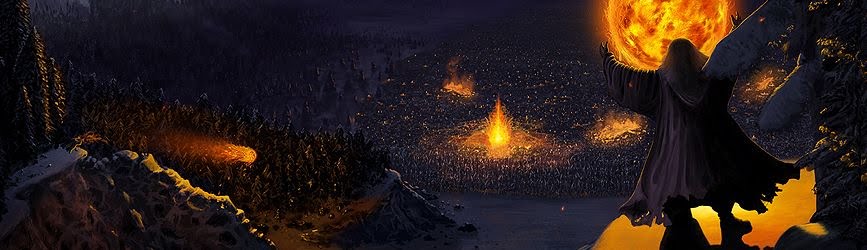
This quarter’s artwork is “Wizard’s Fire” by Simon Cowell. Mr Cowell is a freelance concept artist, Illustrator, and painter living in Sydney Australia.

Friday, December 31, 2010

Happy New Year


And so we bid farewell to 2010.

Here's hoping that the year treated you well and that 2011 will bring only good things in both your personal and professional life.


Thursday, December 30, 2010

DAILY SCIENCE FICTION


A quick plug for the excellent sf webzine Daily Science Fiction.

Doing exactly what it says on the tin, DFS provides subscribers with new sf and fantasy every weekday, spanning the length and breadth of the genre(s) from traditional fantasy to hard sf and everything else in between.

It's free and only takes a couple of clicks to subscribe.

Go on, you know you want to.


Wednesday, December 29, 2010

THIN BLOOD AT AURORA WOLF


I've just received word that my short story Thin Blood has been accepted by Aurora Wolf and should be online this weekend. It's a Celtic fantasy and one of my first attempts to use elements of Irish mytholgy in my writing.


It'll be a good start to 2011 and hopefully a good omen for the coming year.


You can find Aurora Wolf here: http://aurorawolf.com/

Sunday, December 26, 2010

BOOKTRUST IN DANGER


In an act which is probably best described as cultural barbarism, the UK government has cut the subsidy to the UK based book charity Booktrust, taking away some £13 million pounds.

The charity's national book-gifting programmes are well-known and wide-reaching. Bookstart gives a free pack of books to every baby in the UK, Booktime donates a book pack to children shortly after they start school, and Booked Up enables each child starting secondary school to choose a book for themselves. The charity's aim is to give everyone the chance to experience what it calls "the delight and power of books and the written word" regardless of income, literacy skills, disability or culture.

The government's £13m was used to generate a further £56m-worth of sponsorship for the bookgifting schemes from publishing partners and corporate sponsors.

In an age when concerns about literacy levels are increasing every day, and the cost of higher education is becoming prohibitive for all but the well off (or those prepared to start their working lives with debts of more than £30,000) it is nothing short of madness to add to this trend rather than attempt to solve it.

If I was a writer of speculative fiction (and I am) I would see this as the first step towards creating a drone underclass, incapable of anything other than taking orders from those who have set themselves up as their social superiors. Eugenics, anyone? There is a chilling Orwellian taint to this whole thing, mixed liberally with a touch of Aldous Huxley, and a whole helping of Thatcherism.

To my mind it is only common sense to help create a literate, educated population, particularly in a time when traditional industry has all but vanished from the United Kingdom and when we need to look more and more to non-traditional and creative industry but without an educated population we cannot do this.

Our government is a sham, to say the least, caring little or nothing about the working classes, or indeed the middle classes.

Many writers, teacher and librarians have already expressed their dismay and disgust at the withdrawal of the Booktrust's funding, (leading to a partial about-face by the Liberal/Conservative government.) I am adding my voice to this, if you care about the future of literacy in this country, please add yours.

Friday, December 24, 2010

Locus Online: And Other Such Delights


Some late breaking news:
My short story "And Other Such Delights", which appeared in the excellent Beneath Ceaseless Skies earlier this year, has been mentioned in Lois Tilton's Short Fiction Reviews in Review at Locus Online as part of her summary of the best fiction from 2010.
I am rather delighted!

Thursday, December 23, 2010

THROUGH BLOOD AND IRON


Today I recieved the final edits for my short story, Forged in Heaven, Tempered in Hell, which features in the new Ricasso Press anthology Through Blood and Iron, due in 2011.

Edited by Rob Santa and showcasing heroic fantasy and sword & sorcery in all its action-packed glory, the anthology features a whole bunch of excellent writers including Christopher Heath, Bruce Durham, Nathan Meyer, TW Williams, Steve Goble and many more.

I am, to say the least, delighted to be in such august company.

Thursday, December 16, 2010

On Writin' and Readin'


"I always advise people who want to write a fantasy or science fiction or romance to stop reading everything in those genres and start reading everything else from [John] Bunyan to [A.S.] Byatt." Michael Moorcock

"I hate those writers who have been terribly influenced by Lord Kafka or Franz Dunsany -big show offs. Personally I was influenced by guys like Clifford Simak and John W. Campbell Jr... A fellow with science fiction writing ambitions should read science fiction." Isaac Asimov.

I recently re-read the above quotes and it got me thinking about my own reading habits. First of all, as I have said many, many times before, I am an unashamed and unabashed lover of science fiction and fantasy literature (quite a lot of movies and TV stuff too, but let's just stick to books for the moment, shall we?) and it makes up a large part of my literary diet. In the last year I have read (or re-read) books and stories by Joe Abercrombie, Robert Silverberg, M. John Harrison, Clark Ashton Smith, Robert E. Howard, Tanith Lee, Scott Lynch, Stephen King, Philip K. Dick, Karl Edward Wagner, Jack Vance, Peter Brett, Mark Charan Newton, Michael Moorcock, Andrzej Sapkowski, Brian Aldiss and JG Ballard (to mention quite a few) and thoroughly enjoyed them.
Equally I have read (or re-read) works by Joseph Conrad, Voltaire, Malcolm Lowry, Italo Calvino, Gabriel Garcia Marquez, William Shakespeare, T.S Elliot, William Blake, Jean Paul Satre, Virginia Wolff, May Sinclair, Martin Amis, Wells Tower, Dante, Graham Greene, Charles Bukowski, Daniel Defoe and Christopher Isherwood (to name virtually all of them) and gained a huge amount of pleasure from those as well.

As if that wasn't enough I've also read histories of the Crusades, the Greek and Persian Wars, the Peloponnesian Wars and the fanciful studies of Atlantis and Lemuria by William Scott-Elliot (which are a hoot and a half).

I've also read a fair bit of Kafka and Dunsany over the years, too, so I guess you could say that I read a lot and like to keep it varied.

For me, reading science fiction and fantasy is and always has been a pleasure, but I fully understand that a writer can get stymied by following such a path and runs the risk of disappearing up a literary cul de sac. Michael Moorcock makes a good point, particularly if you are more interested in literary growth than straightforward adventure stories, and is a good warning against simply recycling well-worn tropes and plots. But by the same token, though, I agree with the words of Isaac Asimov in that too much of the overtly literary can alienate a reader (or a writer) who is simply looking for entertainment and, of course, if you are not familiar with the tropes and plots of sf there is always the chance that you will recycle them unwittingly (working for weeks or months on that Grandfather Paradox story only to discover that Robert Heinlein did it years ago).

The truth lies somewhere in the middle, I feel. Opinions on what constitutes good science fiction and fantasy vary wildly, even within one person's own judgement - I hugely admire M. John Harrison's Viriconium sequence, for example, but also absolutely adore the work of Philip K. Dick although he was never a literary stylist in that same way that Harrison is. Is one necessarily better than the other? No, of course not.

As readers we take away different things from different writers, regardless of the genre in which they work (given that we can refer to 'literary' fiction as a genre), something that is doubly so as a writer: lessons about structure, point of view, handling the narrative, characterisation etc. I

It's healthy, I feel, for a writer to read both within and outside of his or her chosen genre, adapting techniques to suit their own writing, using literary experimentation when it suits or fits. After all, the world of books is a huge one... why limit yourself?

Saturday, December 4, 2010

SKULL SALAD REVIEWS: THE SONG OF TUSSAGAROTH

Some very kind words about The Song of Tussagaroth and Innsmouth Free Press from Deborah Walker at Skull Salad Reviews where she describes the story as "reminiscent of Clark Ashton Smith". (Wheeeee!)

To say that I am delighted would be the understatement of the season, particularly since The Song of Tussagaroth was/is my attempt to do a story with a Hyperborea vibe to it and is the first of a series of sword and sorcery mythos tales that I've been tinkering with over the past while.


You can read the review here: