Friday, April 15, 2011

Bride of the Water at Lacuna


Breaking something of a dry season, my short story Bride of the Water, is currently online at Megan Arkenberg's splendid e-zine of historical fiction, Lacuna.


Set in Renaissance Venice, it's the latest of the Lovecraftain style tales I've been working on recently. More than that I may not say.


Tuesday, March 29, 2011

Gettin' all 21st Century


Those who know me are probably aware that I am something of a confirmed and committed bibliophile. Reading is, quite simply, one of my favourite things and I regard books as almost sacred objects.


However, last week I finally cracked - gave in to the pressures of the modern world, if you will - and bought myself a Kindle. Yes, you read that correctly, I bought a Kindle.


And I have to say that it is a wonderful toy.


My reasons were rather pragmatic, truth to tell. I've never been happy reading books on a computer screen, (short stories are fine although I've always had a tendancy to print them out and read them at my leisure) but over the past few years I have amassed a rather large collection of ebooks, gleaned from various places (God Bless You, Project Gutenberg, Manybooks, and Black Mask, among others).


Now, thanks to the Kindle I can read them in comfort, take them with me wherever I go and generally enjoy them without the hassle of the computer, eye-strain and things of that nature.


I was sceptical at first and still believe that the ebook reader will never fully replace the printed word, but given the vast amout of books available in electronic format, it's been a good investment so far.


It has even got me thinking about producing an e-collection of my own - it's relatively easy to do given the right software (Calibre is a good 'un) and has helped bring me out of one of my occasional periods of creative lethargy.


So, stay tuned - the plan is to put a collection together in the next couple of months (probably of my Shining Cities stories as soon as the rights of a couple of them revert to me) and see where things go from there.


Will this stop me from buying printed books? Er, no (see the whole bibliophile comment above)


And, besides, I reckon it's about time I joined the 21st century (albeit in a small way).


Wednesday, March 23, 2011

Valhalla Rising (2009)


Directed by Nicholas Winding Refn. Starring Mads Mikkelsen.
Gritty sword and sorcery with an historical veil, Valhalla Rising is something of a divisive film. Depending on your point of view it is either carefully composed, enigmatic, elegantly paced with bouts of balletic yet brutal violence or simply extremely dull and pretentious.

I rather incline towards the first rather than the second.

In Valhalla Rising Mads Mikkelsen plays One-Eye, a mute and practically unstoppable killing machine of a man, whose one mode of expression is violence. When first we meet him he is being used as an attack dog/gladiator by a group of Norse raiders. Tethered to a post, One-Eye is forced to fight other warriors to the death, the fact that he is unarmed every time makes little or no difference. Only a young boy, Ave, treats him with any degree of humanity, his 'Masters' being more interested in the money he can make them than in treating their 'dog' well.

One-Eye, however, has another, more arcane ability to see into the future and in doing so finds the weapon he needs to free himself from captivity, which he does with chilling brutality slaughtering everyone except Ave.

Later they joins with a band of Scottish en route to Jerusalem and instead of the Holy Land ends up in strange and savage land that some of them believe to be Hell itself. Thereafter follows journey into a heart of darkness that is as compelling as it is sometimes brutal.

A literal and metaphysical journey for its main protagonist, Valhalla Rising is a beautifully shot film, making brilliant use of its Scottish locations and in Mads Mikkelsen it has a central character who is every bit as enigmatic as the film itself. Mute and with a masklike expression throughout, One-Eye is nevertheless a compelling character, echoing rage, hatred, frustration and even compassion in that blank, fathomless face. It is One-Eye who is the focus of much of the violence throughout, although rarely as instigator.

In terms of style and pacing Valhalla Rising could be compared to Herzog's Aguirre – Wrath of God – the same atmosphere of grim fatalism permeates both films – or Jim Jarmush's Dead Man with its slow build up and sudden, albeit brief, bursts of action. What all three certainly share is a charismatic central performance, and here Mads Mikkelsen is quite simply extraordinary as One-Eye doing more with that one, fixed, expression than most actors can do with their entire bodies.

As with Bronson, Nicholas Winding Refn's other study of violence and violent men, the self-conscious and studied art house sensibilities of Valhalla Rising may not be to everyone's taste but for those with a taste for the less travelled cinematic roads it is a treat.
 
Released in the UK in the wake of 300, the film was promoted as an action adventure, a Viking version of Thermopylae if you will, and doubtless to the chagrin of many who were expecting a repeat of 300's high octane visuals and Hollywood gloss. But Valhalla Rising is a much more challenging film less concerned with the spectacle of violence and more about its effects on the soul.

Not an easy watch, but a rewarding one.

Sunday, March 20, 2011

SIX STRING SAMURAI (1998)


Directed by Lance Mungia. Starring Jeffrey Falcon, Justin McGuire.


It's movie week on the Computerbank, and what better film to start with than this?

A potent blend of Max Mad, Lone Wolf and Cub, 'fifties rock n roll and general surrealism, Six String Samurai is one of those movies so outrageous in both concept and execution that the only proper response is to cry Hallelujah!

In an alternative America, nuked and conquered by the Russians in 1957, the only bastion of freedom is the city of Lost Vegas, ruled for the past 40 years by King Elvis But now the King is dead and the throne needs a new occupant, bringing every sword swingin', guitar pickin' opportunist across the Nevada badlands eager to get their hands on the kingdom.

Among them is Buddy (Jeffrey Falcon), a bespectacled musician/latterday ronin, and even Death himself (Stephane Gauger although voiced by Lex Lang) manifested as nothing less than an avatar of Slash, complete with top hat, guitar and heavy metal sidekicks. Essentially a picaresque tale of swordfights and freaks as Buddy finds himself saddled with a young orphan boy (Justin McGuire), trailed by Death and hunted by all and sundry for his 1957 cherry-red Gibson guitar. Unfortunately for both all and sundry – including the Red Elvises, the Windmill People and the Pin Pals (three psycho bowlers, in case you were wondering) – Buddy is equally adept with a sword as he is with a guitar.

Shamelessly borrowing from any number westerns and Samurai movies (although most notably from the aforementioned Lone Wolf and Cub series even down to the every popular 'one man takes on an army sequence) as well as a cheeky nod to the cantina sequence in Star Wars, Six String Samurai is a movie that very much wears its influences on it sleeve.

Belying its low budget limitations with verve, wit and imagination, making good use of its desert locations, (something it has in common with Ryuhei Kitamura's equally demented Versus) Six String Samurai is most definitely one of those 'love it or loathe it' kind of films (for the record, I loved it).

Of particular note is the soundtrack by Brian Tyler (who performed similar duties on the alt-Elvis classic Bubba Ho-Tep) and the previously mentioned Red Elvises, creating a future-retro rock n roll that gives the movie a jaunty energy even in its darkest moments. Added to this is the wise approach of director Lance Mungia who's 'what you don't see won't disappoint you' attitude pays dividends more often than not (most notably in the scenes featuring the God of the Windmill People and, later, the disappearance of Death's henchmen/ backing band)

Although the ending of Six String Samurai falls into something of a metaphysical muddle (or to put it another way, it doesn't really make all that much sense) the film itself is a fun ride as long as you keep an open mind. A bigger budget might have been nice, of course, but sometimes you just have to work with what you've got – something that Six String Samurai does with aplomb.

Friday, March 18, 2011

MICHAEL GOUGH 1916 - 2011


Recent news reports the passing of the British actor Michael Gough. A stalwart of British horror in its glory days, Michael Gough appeared in a number of movies from both Hammer and Amicus including Dracula, The Phantom of the Opera, Dr Terror's House of Horrors and The Skull, as well as notable appearances in such other films as Trog, Curse of the Crimson Altar, The Legend of Hell House and the truly bonkers Horror Hospital (where his performance as Dr Storm has to be seen to be believed). Later in his career he became part of Tim Burton's 'stock company' appearing as Alfred Pennyworth in the Batman films (continuing the role even after Burton's departure from the series) in the magnificent Sleepy Hollow - surely the biggest budget film that Hammer never made - and adding his voice to Corpse Bride and Alice in Wonderland.


Like Peter Cushing, Michael Gough always brought a certain dignity to even the most improbable of roles (Dr Storm springs to mind again) and although his career encompassed a wide range of television, film and theatre it is probably for his contribution to fantasy cinema that he will be rightly remembered.


Friday, March 4, 2011

MY FAVOURITE SHORT STORIES: THE CITY OF DREADFUL NIGHT BY RUDYARD KIPLING


(It's been a while since I did one of these so I thought 'Why not?')

First published in 1887, Rudyard Kipling's The City of Dreadful Night is as nightmarish a little tale as you could wish to read, a macabre journey through the nocturnal city of Lahore that in some ways prefigures Magic Realism in its darkly poetic transformation of the realistic into the utterly fantastic.

Racked by sleeplessness on a stiflingly hot night, the unnamed narrator (presumably Kipling himself) choses a random direction that takes him into the walled city itself, along a highway flanked with sleeping men, to climb the Mosque of Wazir Khan in search of a cool breeze.

In terms of narrative, that's your lot, similarly character development, obstacles to be overcome or any other of the accepted ingredients in the modern short story stew, and its precisely this freedom from narrative convention that allows Kipling to paint his vivid nightmare and that gives The City of Dreadful Night its power. It is, if you like, a fantastical piece of reportage, although very firmly anchored in the reality of 19th century Lahore, taken from the skewed perspective of the chronic insomniac.

The description of a 'disused Mahomedan burial-ground', sets the tone 'where the jawless skulls and rough-butted shank-bones, heartlessly exposed by the July rains, glimmered like mother o' pearl on the rain-channelled soil. The heated air and the heavy earth had driven the very dead upward for coolness' sake.' but is only the beginning of a brief but intense phantasmagoria where sleeping men lie like 'sheeted corpses... some face downwards, arms folded, in the dust; some with clasped hands flung up above their heads; some curled up dog-wise; some thrown like limp gunny-bags over the side of the grain carts; and some bowed with their brows on their knees in the full glare of the Moon.'

Taking both its title and tone from James Thomas' poem (which itself presented a nightmarish vision of Victorian London in all its polluted, industrial glory) The City of Dreadful Night is Kipling at his most powerful, macabre image piled upon macabre image where even the simple act of a man throwing 'a jar of water over his fevered body' becomes something much more siniister - 'the tinkle of the falling water strikes faintly on the ear. Two or three other men, in far-off corners of the City of Dreadful Night, follow his example, and the water flashes like heliographic signals' and the disappearance of the moon behind a cloud heralds an even deeper sense of horror than the 'sickly warm flood of light' which had pervaded both city and story before.

While his Imperial outlook tends not to sit well with modern audiences, Kipling was nevertheless a master of mood and, like Robert Louis Stephenson before him, had the uncanny knack of being able to pick exactly the right word at the right time. You can feel the heat of the Indian night, smell the 'evil savours, animal and vegetable, that a walled city can brew in a day and a night' and feel the sense of fragmenting reality that the narrator experiences as he walks through the nocturnal streets.

As the evocation of a waking nightmare The City of Dreadful Night has few equals and its influence can be felt in such works as M. John Harrison's Viriconium, Tanith Lee's Paradys and in the more baroque elements of C.J Cherryh's Sunfall sequence. If you've never read Kipling before, or thought him merely a writer of stirring adventure stories, The City of Dreadful Night may give you a new perspective on this fascinating and often brilliant writer.

Wednesday, February 23, 2011

NICHOLAS COURTNEY 1929 - 2011


Recent news reports the death of the actor Nicholas Courtney, probably best known to genre fans for his portrayal of Brigadier Lethbridge-Stewart in Dr Who.


A regular in the series during the 1970's and 1980's he also made appearances in such fantasy television shows as The Avengers, The Champions and Randall and Hopkirk (Deceased) as well as playing many other roles in a variety of television, radio and film.


The very epitome of the unflappable English officer, his portrayal of The Brigadier was, for me, one of the highlights of the Jon Pertwee years and I still shudder ever so slightly whenever I pass a shop window filled with mannequins, half expecting them to come to life a la the Autons.


Friday, February 18, 2011

WITH MANY SHADES UPDATED


For those of you who are interested in such things, I've just updated by other blog, With Many Shades. The updates include new issues of Beneath Ceaseless Skies, The Absent Willow Review, Ray Gun Revival, EDF & Daily Science Fiction.


Wednesday, February 2, 2011

The Unsinkable HPL


News of a new online zine of Lovecraftian fiction - The Lovecraft Ezine.


Issue one is currently available online and features new fiction from Bruce L. Priddy, William Meikle, John Prescott and Bruce Durham.


With both this and the excellent Innsmouth Free Press (new issue available soon), it seems that the influence of H.P Lovecraft and appetite for Mythos fiction is continuing on apace. From pulpster to literary giant... not bad going.


As HPL himself wrote: “That is not dead which can eternal lie, yet with stranger aeons, even Death may die.”


You can find out more about The Lovecraft Ezine here http://lovecraftzine.wordpress.com/ and Innsmouth Free Press here: http://www.innsmouthfreepress.com/

Friday, January 21, 2011

HOORAY FOR HOK


Next month sees the release of Battle In The Dawn: The Complete Hok the Mighty by Manly Wade Wellman.

Published by the very wonderful Planet Stories imprint of Piazo, this represents the first time that Wellman's prehistoric hero appears in a complete and authorized edition.

I've only read a couple of the Hok stories in the past and they are wonderful - stone age sword and sorcery (so to speak) stories that first appeared in the 1930's and which Wellman added to even up to the time of his death. In fact, one of the last incomplete fragments that Wellman left behind was the start of a new Hok story.

I'm really excited about this new edition, Planet Stories have done a great job of keeping pulp fiction alive, publishing collections and novels by such authors as CL Moore, Henry Kuttner, Michael Moorcock, Leigh Brackett and Robert E. Howard, most of which have been sadly out of print for many years (such as Kuttner's Elak of Atlantis stories which deserve a place on the shelves of any self-respecting sword and sorcery fanatic).

You can find out more about Hok, Battle In the Dawn and Planet Stories here:

Sunday, January 16, 2011

TUSSAGAROTH REVISITED


Some more nice words about my S&S Mythos tale The Song of Tussagaroth, which appeared in the October issue of Innsmouth Free Press, this time from Angela Spencer in the pages of Rise Reviews.

“The Song of Tussagaroth” by James Lecky proved to be an unexpected piece to find in the magazine. This lovely piece of dark fantasy was more closely related to Howard’s Hyborian Age or Lovecraft’s Dreamlands than the usual nods to Lovecraft’s work. As best I can tell it is the author’s own setting as well, as is the old god Tussagaroth that lends the story its name. It was a fun piece to read and an interesting break from the other stories."

Angela has good things to say about the magazine, too. You can read the full thing here:

Saturday, January 15, 2011

WITH MANY SHADES


A quick plug for my other blog, With Many Shades. As regular readers might know. With Many Shades is a listing of various online, and occasionally print, publications that fall into the category of science fiction and fantasy.

It's a hopefully decent enough resource for both reader and writers. if you haven't checked it out yet then please do (and maybe consider following the blog, too, it needs all the followers it can get)

And that's all I have to say about that.

Tuesday, January 4, 2011

THIN BLOOD AT AURORA WOLF


My Celtic flavoured fantasy Thin Blood is currently available to read at Aurora Wolf.

It's the first of what I hope will be a new series of tales set in Orialla, which is my fantasy version of Ireland.

The stories (there are currently two of them) have a slightly more upbeat tempo than most of my other pieces - at least, I think they do, it's hard to tell sometimes.

This issue also contains a new story, Masks, by the excellent Megan Arkenberg.

You can find Thin Blood here: http://aurorawolf.com/2011/01/thin-blood/

Monday, January 3, 2011

GETTING INTO 2011


Well, the New Year has begun and I think a lot of resolutions have already been broken. Not by me, though, since I didn't make any.

One thing I did make my mind up to do, however, was to revisit a few of those stories that remain unfinished and see if the passing of time has helped with those tricky little plot turns that effectively painted them into corners.

What struck me first and foremost was exactly how many of these stories I have: two unfinished Tulun stories (one of which is currently hovering at the 8,000 word mark), Three that fall into my Shining Cities sequence and at least half a dozen others ranging from a new Mythos sword and sorcery story to a steampunkesque 'multiverse' tale to the odd foray in 'straightforward' sf.

Most of all, I realised that I have 14,000 words of a novella that I've been working at on-and-off for the last while (it's a sort of alternative world thing where the sorce of magic is dragon's blood and the dragons - or dreki - are hunted for them in much the same way that whales were hunted during the 19th century).

With no false modesty, most of these stories aren't bad (although a couple are right stinkers and I know why I gave up on them) and certainly deserve to be finished. After all, no one is going to read a story that still sitting on my hard drive or in my notebooks (this, by the way, applies to every writer and not just me).

So I have made up my mind to get these particular stories finished. Not a resolution, you understand, more of a duty to those characters who have remained in literary limbo for too long. Hopefully they'll forgive me for leaving them.

Sunday, January 2, 2011

HEROIC FANTASY QUARTERLY ISSUE 7


The newest issue of Heroic Fantasy Quarterly is live and unleashed for your reading pleasure.

Fiction Contents

LORD OF THE BRASS HOST, by Dariel Quiogue
Dare we call this beauty a tale of S&S steampunk upon the steppes? We dare!

THE LAST FREE BEAR, by J. S. Bangs
Hope drives them across the tundra, and revenge into a world of legend!

SHATTERING THE SPEAR, by P. Djeli Clark
When the forces of the Witch Priest threaten the Southlands, only the mighty Zhusa and their allies stand in the way. But are unbreakable spears enough to stop this ancient evil . . .

Poetry Contents

LAMENT FOR THE FATHERS, by Joshua Hampton
A poem seemingly straight from the middle ages! With this his second poem to grace our electronic pages, Mr. Hampton currently reigns as HFQ’s Poet Laureate. (You can check out the prior here, from the halcyon days of ’09.)

METTLE, by Scott Matthews
We couldn’t have asked for a better winter poem. Short but powerful, certain lines of this piece are sure to warm the hearts of heroic fans everywhere — you’ll know ‘em when you see ‘em!

Art
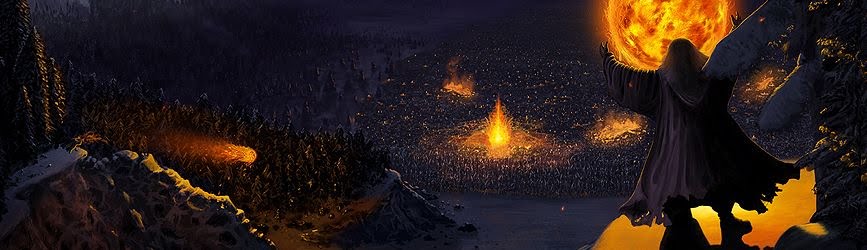
This quarter’s artwork is “Wizard’s Fire” by Simon Cowell. Mr Cowell is a freelance concept artist, Illustrator, and painter living in Sydney Australia.